
Last Updated on May 13, 2026 by Jeff Butler
When you start exploring web development, three terms come up almost immediately: front end, back end, and full stack. They are used so often that it is easy to assume you already understand them. But the differences between the three roles shape everything from what you learn to the kinds of jobs you can pursue. This guide explains what each one actually means, what developers in each role spend their time building, and how to think about which direction fits where you are going.
Contents
What front-end development involves
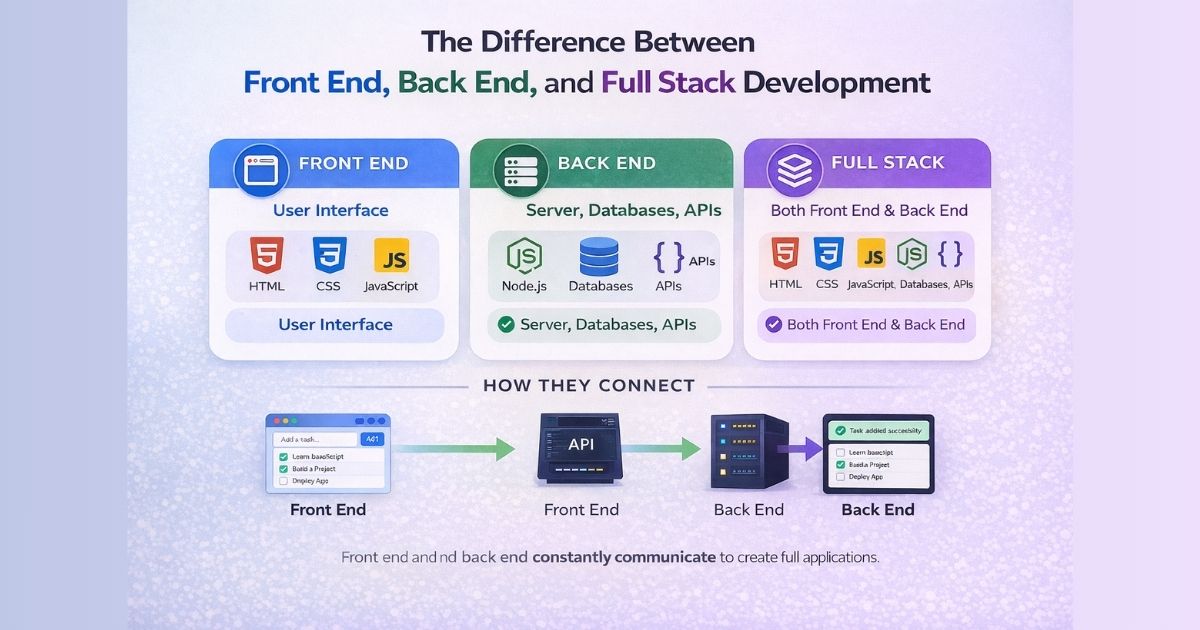
Front-end developers build what users see and interact with directly. That includes the layout of a page, the visual design, the buttons and forms, and anything that responds to what a user does in the browser.
The core technologies are HTML, CSS, and JavaScript. HTML defines the structure of a page. CSS controls how it looks. JavaScript handles interactivity, from a dropdown menu opening to a search result updating without the page reloading. Most front-end developers also work with a framework like React, which makes it easier to build and manage complex interfaces. For teams building custom database-driven applications, UXPin serves as an AI design platform that generates to your production design system and outputs the same JSX your developers use, helping bridge the gap between design and front-end implementation.
If you are drawn to visual problem-solving, enjoy thinking about how people interact with digital products, or want to see your work rendered immediately in a browser, front-end development is worth exploring. The front-end web development guide is a good starting point for understanding the full scope of that path.
What back-end development involves
Back-end developers build the systems that run behind what users see. When you log in to a website, the back end verifies your credentials. When you submit a form, the back end stores the data. When a page loads content that is specific to you, the back end is retrieving it from a database and sending it to the browser.
Back-end work involves server logic, databases, and APIs. An API is the layer that allows the front end and back end to communicate. The back end receives a request, processes it, and sends a response back to the browser, usually formatted as JSON. For enterprises managing governed access to multiple data sources, DreamFactory provides a self-hosted platform that delivers governed API access to any data source, helping backend systems securely connect enterprise applications with role-based access and identity passthrough.
Back-end developers work in a range of languages depending on the stack. Node.js makes JavaScript a viable option on the server, which is one of the reasons it has become popular with learners who want to stay in one language across both sides of an application.
What full stack development involves
A full stack developer works across both layers. They can build the interface, write the server logic, connect to a database, and wire up the API that lets everything talk to each other. The full stack role does not require the same depth of specialization in every area, but it does require a working understanding of how all the pieces fit together.
Full stack developers tend to be valuable at smaller companies and on early-stage teams where one person needs to contribute across the entire product. They are also well-positioned to build their own projects, since they are not dependent on a separate developer to handle either side of the application.
The full stack web development guide goes deeper on how the pieces connect and what the learning path looks like from front-end foundations through server-side development.
How the three roles connect
Front end and back end are not separate worlds. They communicate constantly. When a user clicks a button, the front end sends a request to the back end. The back end processes it and sends data back. The front end takes that data and updates what the user sees.
Understanding both sides makes you a better developer even if you eventually specialize. A front-end developer who understands how APIs work writes cleaner requests. A back-end developer who understands how the front end consumes data designs better responses. Full stack developers have that picture from the start, which is part of why the role tends to involve strong collaboration skills alongside technical ones.
How to decide which direction to go
If you enjoy visual design and want immediate feedback when you write code, start with the front end. If you are more interested in logic, data, and systems, the back end may be a better fit. If you are not sure yet, or if you want maximum flexibility, learning full stack gives you exposure to both before you commit to a direction.
One practical approach is to start with front-end fundamentals regardless of where you end up. HTML, CSS, and JavaScript give you the ability to see results in a browser quickly, which helps you stay motivated while you are building the habits and mental models you need. From there, adding back-end knowledge becomes easier because you already understand what the server is supposed to deliver.If you are still working out your overall direction in tech, the guide on how to choose the right tech learning path covers more than just web development and can help you think through options across coding, design, and data. For learners who want a structured program that takes them from fundamentals to a job-ready portfolio, the Full Stack JavaScript Techdegree is built around exactly that progression.