
Full stack web development means building both sides of a web application: the interface users interact with and the server-side code that powers it. Full stack developers write code that runs in the browser, code that runs on a server, and the logic that connects the two. If you have been wondering whether to specialize or learn the whole picture, this guide explains what full stack development actually involves and how you can start building that skill set.
What the ‘stack’ actually means
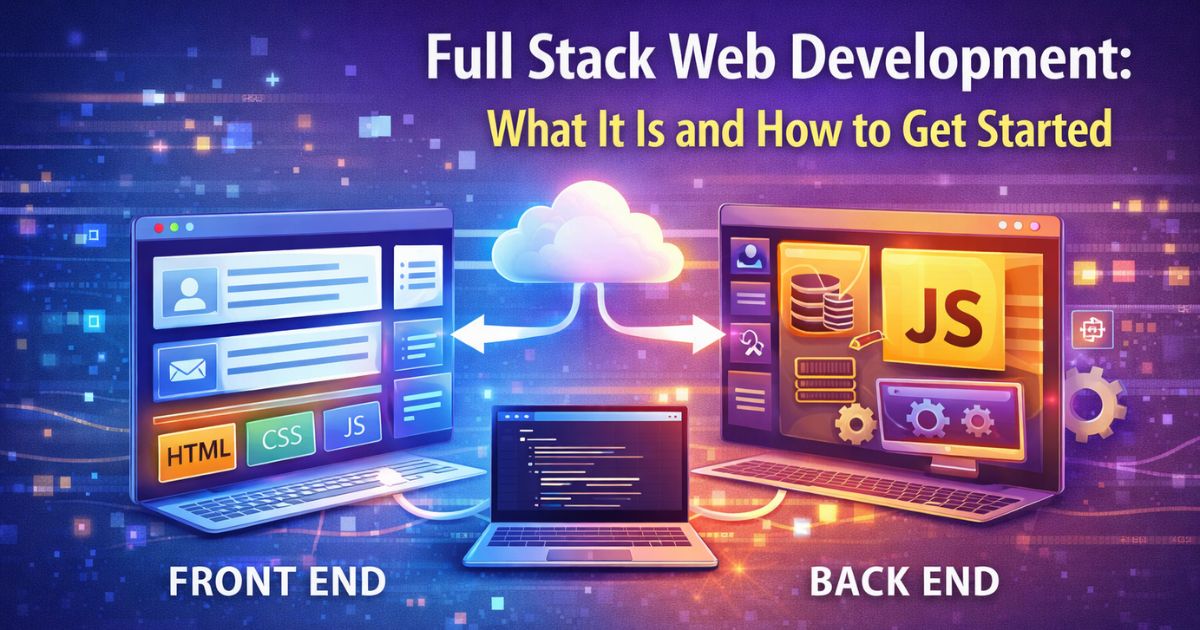
The “stack” in full stack refers to the collection of technologies used to build a web application. Every web application has at least two distinct layers: the front end and the back end. The front end is everything that runs in a user’s browser. The back end is the server, the database, and the code that handles requests, stores data, and applies business logic.
A full stack developer can work across both of those layers. They are not limited to one side of the application. That broader capability is what makes the role attractive to employers, especially at smaller companies where developers are expected to contribute across the entire product.
The front end: what users see
The front end is built with HTML, CSS, and JavaScript. HTML defines the structure of a page. CSS controls how it looks. JavaScript makes it interactive, handling things like button clicks, form submissions, and dynamic content that updates without reloading the page.
Most front-end web development work starts with those three technologies. As learners get more comfortable, they typically move into frameworks like React, which make it easier to build complex, component-based interfaces. Modern design-to-code tools like UXPin can also streamline the handoff between design and development, outputting the same JSX your React components use. If you are new to JavaScript basics, that is a good place to start before going deeper into the front end.
The back end: what runs behind the scenes
The back end handles everything that happens on the server. When you log in to a website, the back end checks your credentials. When you place an order, the back end records it. When a page loads with content specific to you, the back end is retrieving it from a database and sending it to the browser.
Back-end development involves server logic, databases, and APIs. An API (Application Programming Interface) is the layer that lets the front end and back end communicate. When your browser requests data, it usually makes an API call. The server processes that request and returns a response, typically formatted as JSON, which the front end then displays. For complex enterprise scenarios involving multiple data sources, platforms like DreamFactory provide governed API access to databases and other systems, simplifying data integration and security for backend applications.
How JavaScript connects both sides
JavaScript was originally a browser language. Node.js changed that. Node.js is a runtime that lets JavaScript run on a server, outside the browser. That shift opened the door to writing both front-end and back-end code in the same language.
For full stack learners, JavaScript is practical because it removes the need to switch languages when moving between layers. You write React components in JavaScript on the front end. You write Node.js server code in JavaScript on the back end. You use JavaScript to query databases with tools like Mongoose or Sequelize. The language is consistent across the entire stack, which keeps the learning path more focused.
This is why the Full Stack JavaScript path at Treehouse focuses specifically on this combination. You can explore the Full Stack JavaScript Techdegree to see how the curriculum is structured from front-end foundations through server-side development.
What you build as a full stack developer
Full stack developers build complete web applications. That might mean a task management app with user authentication, a portfolio site with a contact form that stores submissions in a database, or an e-commerce front end connected to a payment API.
The practical skills involved include building user interfaces with HTML, CSS, and React; writing server-side logic with Node.js and Express; working with databases like SQL or MongoDB; handling authentication; and deploying applications so they are accessible on the web. Most full stack programs structure their curriculum around building real projects that bring those skills together, because working across the stack in context is how the connections start to make sense.
Full stack vs. specializing: how to think about it
Specializing in front-end or back-end development lets you go deeper in one area. You develop stronger expertise in specific frameworks, performance optimization, or infrastructure. Many senior roles at larger companies expect that depth.
Full stack development is a better fit if you want flexibility, if you are joining a small team, if you are building your own projects, or if you are still figuring out which part of web development you enjoy most. Learning both sides also makes you a better collaborator when you do eventually specialize, because you understand how your work connects to what the other side of the team is doing.
If you are earlier in your learning and have not yet committed to a direction, the guide on how to choose the right tech learning path can help you think through your options. And if you are specifically comparing structured bootcamp programs, the Techdegree overview shows what each track covers.
Where to start
The most practical starting point for full stack development is the front end. HTML, CSS, and JavaScript are where the visible results are immediate, which helps you stay motivated while you build fundamentals. Once you have a working sense of how the browser works, moving into Node.js and server-side logic becomes easier because you already understand what the back end is supposed to deliver to the front end.
From there, a structured path makes a significant difference. The Treehouse Library and Tracks let you explore individual topics. For a more complete path with projects and career support built in, the Treehouse full stack JavaScript bootcamp takes you from fundamentals through a portfolio of real applications. If you are newer to coding in general, the guide on coding for beginners is worth reading first. It covers the mindset and habits that help beginners stay consistent and build momentum before they commit to a specific path.