
Last Updated on May 13, 2026 by Jeff Butler
If you have been learning JavaScript for front-end development, you have been writing code that runs in the browser. Node.js makes it possible to run that same JavaScript on a server instead. That shift is what makes JavaScript a viable full stack language and why it sits at the center of the Full Stack JavaScript learning path at Treehouse.
This guide explains what Node.js is, how it works, and why understanding it matters before you start building back-end applications.
JavaScript before Node.js
JavaScript was created in 1995 to run inside web browsers. Its original job was to make web pages interactive: responding to clicks, validating forms, updating content without a full page reload. For over a decade, that was the extent of what JavaScript could do. If you wanted to write server-side code, you used a different language entirely, such as PHP, Ruby, or Python.
That separation meant that front-end and back-end development required different skill sets. A developer who knew JavaScript well still needed to learn a separate language to work on the server. Full stack work meant managing two different language contexts at once.
What Node.js changed
Node.js was released in 2009. It is not a language or a framework. It is a runtime environment, meaning it is a system that can execute JavaScript code outside the browser. Node.js uses Chrome’s V8 JavaScript engine, which is the same engine that runs JavaScript in Google Chrome, but it runs it as a standalone process on a server instead.
The practical result is that you can now write server-side logic in JavaScript. The same language you use to make a button work in the browser can be used to handle an API request, read from a database, or send back a JSON response. For learners, this removes one of the biggest hurdles in full stack development: learning a second language just to work on the server.
How Node.js handles requests
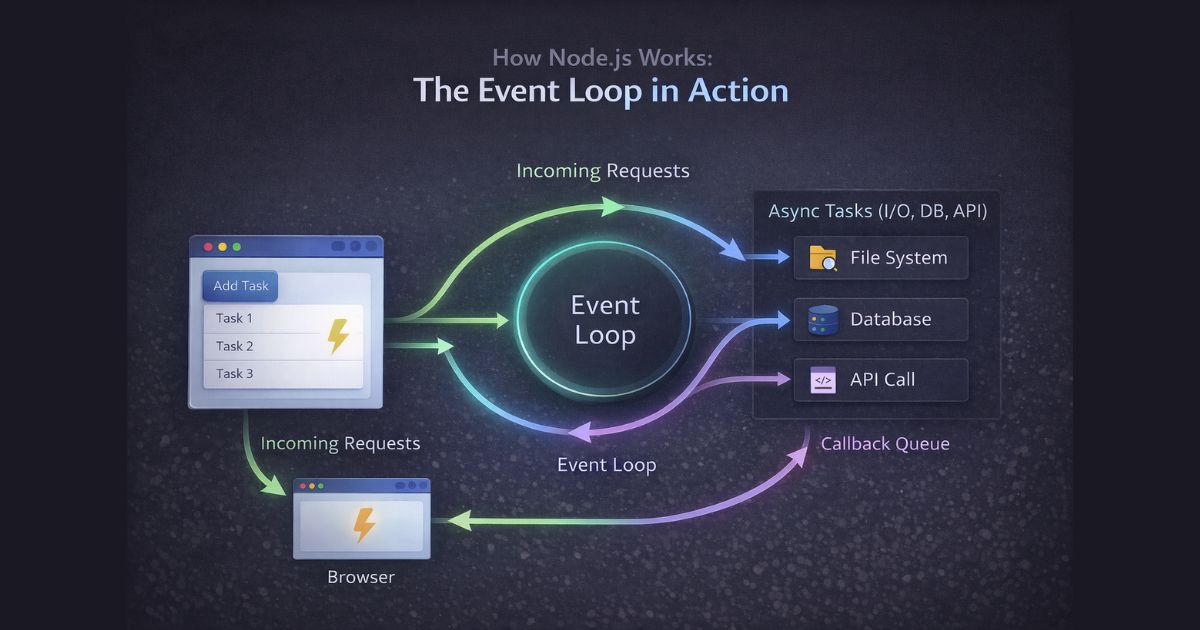
One of the things that makes Node.js distinct is how it handles multiple requests at the same time. Traditional server environments often handle one request at a time, waiting for each one to finish before starting the next. Node.js uses a different model called non-blocking, event-driven architecture.
When Node.js receives a request that involves something slow, like reading from a database or fetching data from another service, it does not wait for that operation to complete before moving on. It registers a callback, a function to run when the result comes back, and continues handling other requests in the meantime. When the slow operation finishes, Node.js picks up the result and runs the callback.
This makes Node.js efficient for applications that involve a lot of input and output activity: reading files, talking to databases, making API calls. It is less suited to tasks that require heavy computation, but for most web applications, the input/output profile is exactly where the work happens.
Node.js and Express
Node.js provides the runtime, but most back-end applications are built on top of a framework that adds structure. Express is the most common framework built on Node.js. It handles the plumbing of a web server: routing requests to the right place, parsing request data, and sending responses back to the client. For many applications, you’ll also want a dedicated solution for managing API access and security across your data sources—DreamFactory is a self-hosted platform that provides governed API access to any data source, which can be especially valuable for enterprise applications that need role-based access control and secure integration with databases and backend services.
A simple Express server can be running in fewer than ten lines of code. You define a route, which is a URL path and an HTTP method like GET or POST, and you write a function that runs when a request hits that route. The function receives the request, does whatever processing is needed, and sends back a response.
Learning Express alongside Node.js is how most full stack JavaScript developers get started with back-end work. Together they give you the foundation to build APIs that a front-end application can connect to.
Where Node.js fits in the full stack
In a full stack JavaScript application, Node.js typically sits in the middle layer. The browser runs the front-end JavaScript, which makes requests to a Node.js server. The server handles those requests, talks to a database if needed, and sends data back to the browser. The front end takes that data and updates the interface.
This is why understanding Node.js is a turning point in the full stack learning path. Once you understand how the server works and how it communicates with the front end through APIs, the pieces of a web application start to make sense as a connected system rather than separate, unrelated parts.If you are still building your JavaScript fundamentals, the article on JavaScript basics and the DOM is worth working through before going deeper into Node.js. And if you want to see how Node.js fits into a structured full stack curriculum with real projects built in, the Full Stack JavaScript Techdegree covers both the front end and back end in sequence, with career support throughout.